
European Universities Alliances: rethinking recognition with Open Badges

Recognition in European Universities Alliances has become a critical challenge as institutions cooperate far beyond traditional exchange programmes. The European Universities Initiative encourages institutions to work together through joint curricula and degrees, student, staff and doctoral mobility, transversal and civic skills development, lifelong learning and micro-credentials.

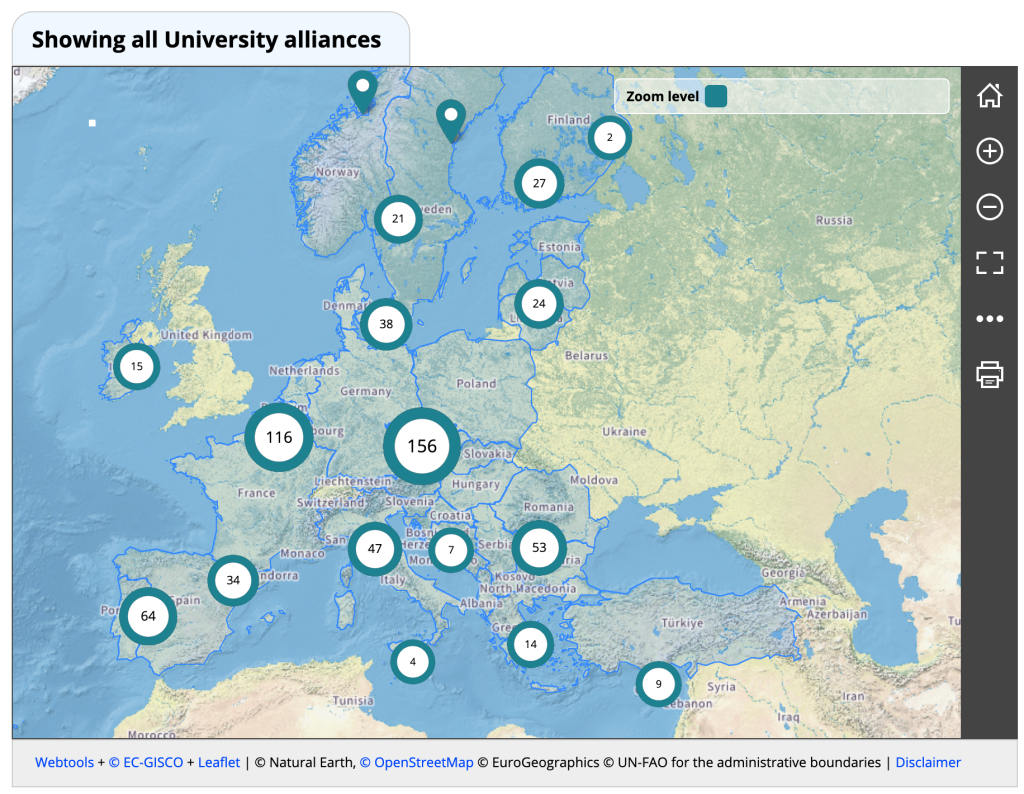
Today, there are 73 European Universities Alliances involving institutions from 36 countries, illustrating the scale and diversity of this initiative.

Through the European Universities Initiative, alliances now support:

  • Joint curricula and degrees
  • Student, staff and doctoral mobility
  • Transversal and civic skills development, including sustainable and digital skills aligned with European priorities
  • Lifelong learning and micro-credentials
  • Engagement beyond formal study programmes

However, recognition practices often remain fragmented across institutions.

Map European universities
See Map of alliances

European Universities Alliances Recognition Explained (Video)

This video explains the recognition challenge in European Universities Alliances and shows how Open Badges provide a shared framework to recognise learning, skills and engagement across institutions.

Video summary: The video introduces European Universities Alliances, highlights why recognition remains fragmented across joint programmes and mobility activities, and explains how Open Badges and the Open Badges 3.0 standard support shared, interoperable recognition frameworks.

Source: YouTube – European Universities Alliances recognition (Open Badge Factory)

Production note: This video was generated using a locally hosted large language model via LM Studio, based on the content and expertise of Open Badge Factory.

A practical challenge: when learning isn’t properly recognised

Imagine a student participating in a joint summer school across three alliance universities. She earns credits, develops intercultural competencies, contributes to a civic engagement project, and collaborates with peers from different countries.
Yet, at the end, she receives only a generic participation certificate that captures none of this richness—and may not even be recognized by her home institution.

This challenge goes beyond alliances and highlights broader issues in recognising learning beyond formal education.  Read also our article: What are Open Badges – And why should students care?
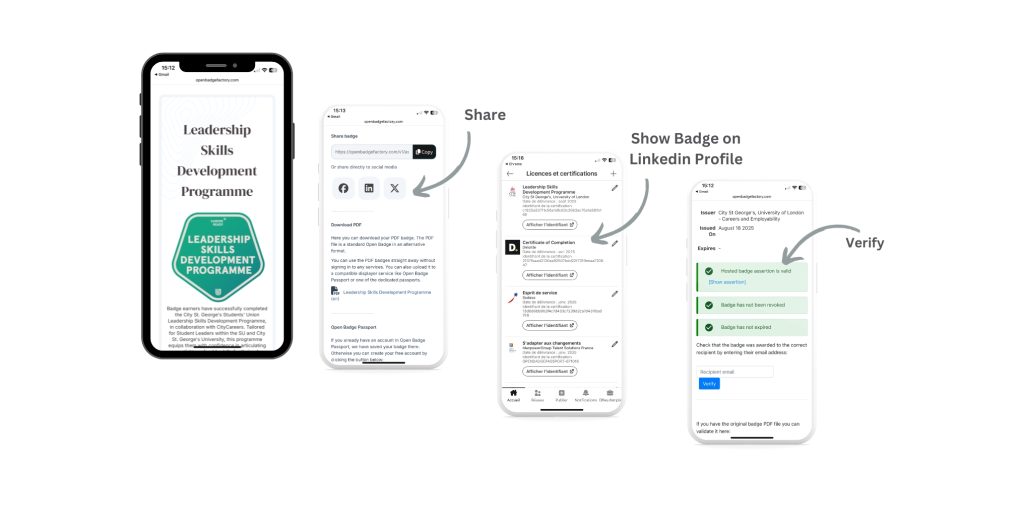
Show badge

Why traditional certificates and isolated micro-credentials are not enough

Traditionally, diplomas and certificates play a crucial role in higher education, but they are not designed to reflect the full diversity of learning taking place within alliances.

  • Diplomas are formal, slow to evolve and institution-specific
  • Certificates often lack transparency and interoperability
  • Isolated micro-credentials can multiply without coherence or shared quality standards

In addition, isolated micro-credentials often lack stackability, creating a fragmented accumulation of credentials without clear coherence or progression for learners across joint programmes.  For students, this results in learning experiences that are difficult to combine, explain, or reuse across institutions and countries.

In complex alliances, therefore, recognition cannot rely solely on certificates or disconnected micro-credentials. What is needed is a framework that combines flexibility, trust and shared standards.

Open Badges as a shared recognition and governance framework

What are Open Badges?

Open badge and meta data

Open Badges are digital credentials that describe skills, learning outcomes or experiences. Each badge includes:

  • Clear and transparent criteria
  • Evidence of achievement
  • Information about the issuing organisation
  • Metadata ensuring interoperability and portability

They can be used to recognise formal, non-formal and informal learning.

Several European Universities Alliances are already experimenting with Open Badges to structure and harmonise recognition across partners. These early initiatives illustrate how shared frameworks can be collectively defined at alliance level while remaining adaptable to local institutional contexts.

From credentials to governance

For European Universities Alliances, Open Badges are not just digital certificates. They enable a shared recognition framework, built collectively and applied locally.

Open Badges function as a governance tool for recognition—meaning they establish shared rules and standards across institutions—not just as digital credentials.

In practice, within an alliance, this means:

  • Common criteria and quality standards defined at alliance level
  • Local issuance by partner universities
  • Shared endorsement and trust across institutions
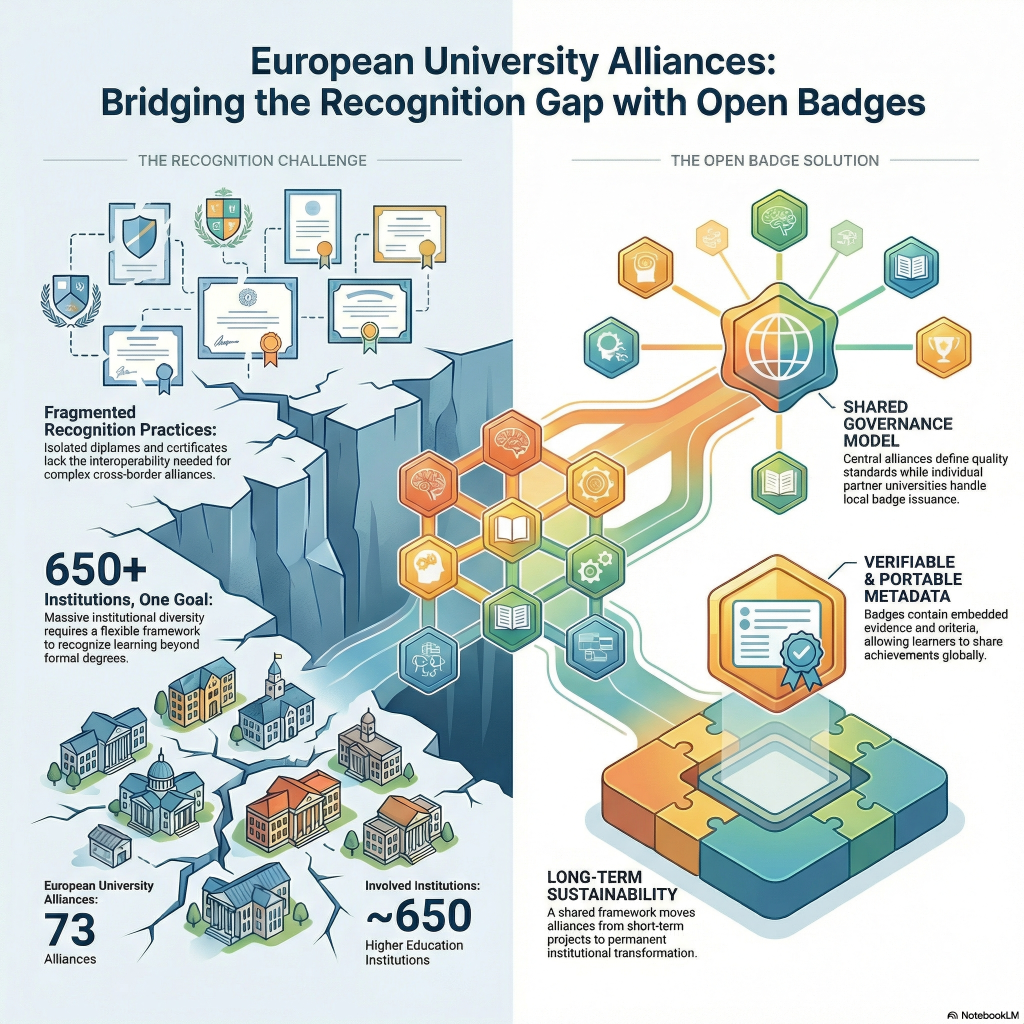
Open Badges and alliances

Open Badge Factory and the Open Badges 3.0 Verifiable Credentials standard

Open Badge Factory has adopted the Open Badges 3.0 standard, which is built on the W3C Verifiable Credentials framework.
This advancement is particularly valuable for European Universities Alliances seeking to develop more consistent and interoperable badge systems.

The 3.0 standard introduces optional fields that enable alliances to define elements critical to their recognition framework:

Achievement Types

Achievement Types allow alliances to categorize and structure their badges according to shared taxonomies—distinguishing, for example, between course completion, skills development, civic engagement, or research activities.

3.0-obfadmin

For instance, an alliance might define achievement types such as:

  • Mobility Experience (5 ECTS)
  • Civic Engagement Project (3 ECTS)
  • Transversal Skills Module (2 ECTS)
  • Joint Research Activity (10 ECTS)

This creates consistency across partner institutions while maintaining clarity for learners and external stakeholders.
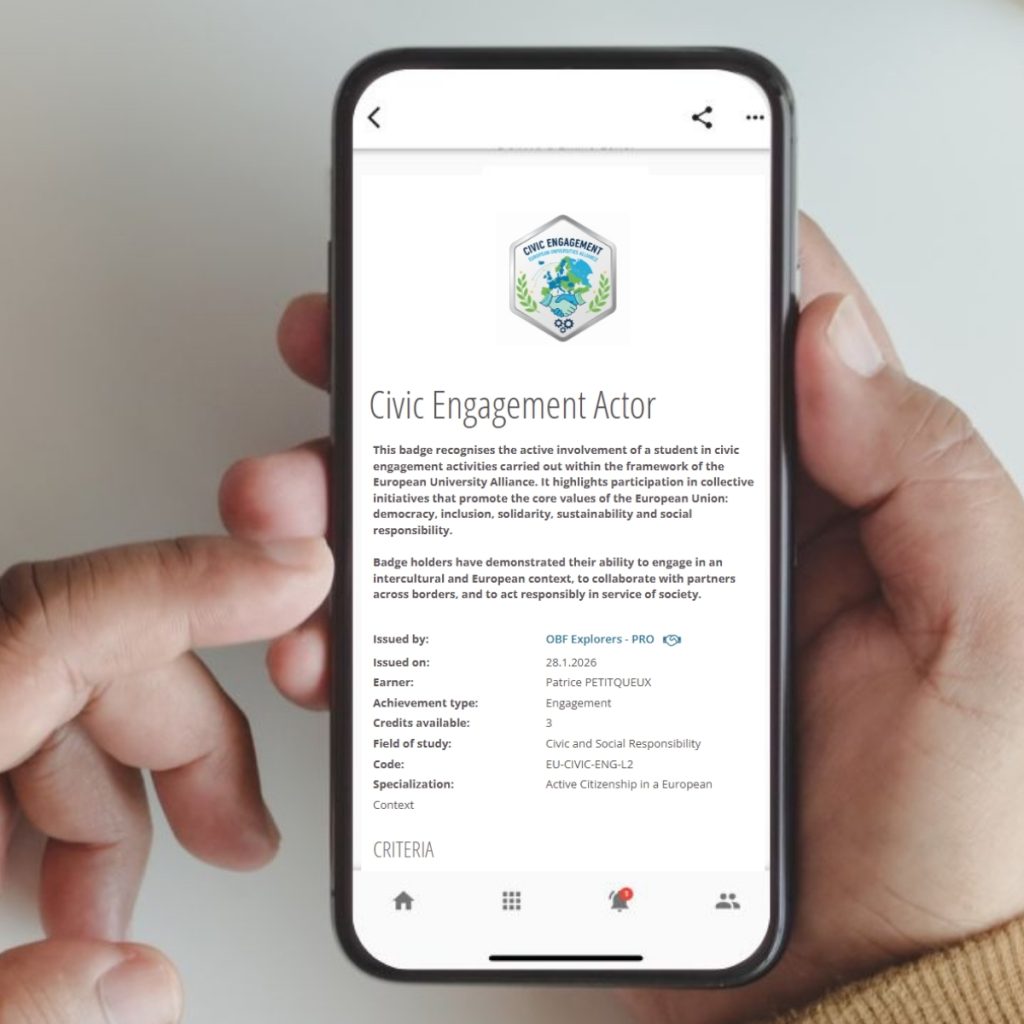
ECTS Credits

ECTS credits can be embedded directly in badge metadata, making credit recognition transparent and machine-readable. This is especially relevant for joint programmes, mobility activities, and micro-credentials within the European Higher Education Area.

By leveraging these standardized fields, Open Badge Factory helps university alliances align their badge systems with common criteria while preserving the flexibility each institution needs. This supports both the governance aims of the alliance and the practical needs of learners navigating diverse educational pathways across Europe.

3.0 badge-alliances

How Open Badges support European Universities Alliances in practice

European Universities Alliances can use Open Badges to harmonise recognition while preserving institutional autonomy.
In practice, Open Badges can support:

  • Recognition of joint programmes and joint learning activities
  • Student and staff mobility across partner institutions
  • Transversal skills, civic engagement and project-based learning
  • Micro-credentials aligned with alliance values and strategies
  • Recognition that remains valid beyond a single Erasmus+ project
  • Recognition that is easily understandable and verifiable by external stakeholders, such as employers, internship providers and civil society partners

A key benefit for alliances lies in the recognition of transversal skills—such as collaboration, intercultural communication or civic engagement—that remain reusable across different European countries and institutions, supporting learner mobility well beyond a single programme or university.

And because Open Badges are portable, learners can store and share them throughout their academic and professional pathways—in digital wallets, on LinkedIn, in CVs, or within institutional systems.

Central governance, distributed issuance, shared trust

One of the key strengths of Open Badges for alliances lies in their organisational model:

  • Central governance: the alliance defines the framework, criteria and values
  • Distributed issuance: each university issues badges locally, according to its own processes
  • Shared trust: badges carry the endorsement of the alliance and are recognized across all partner institutions

Central governance combined with distributed issuance creates shared trust across European Universities Alliances.

This model allows alliances to coordinate recognition without over-centralising processes or undermining institutional diversity. Each university maintains autonomy in how it delivers learning, while the alliance ensures coherence in how that learning is recognized.

Why this matters for the long-term sustainability of alliances

European Universities Alliances are expected to deliver long-term structural transformation, not just short-term project results. A shared recognition framework contributes to this ambition by:

  • Making alliance outcomes visible and reusable across institutions and borders
  • Supporting continuity across funding cycles and beyond project lifespans
  • Strengthening the alliance’s identity and external visibility
  • Enhancing trust among partners, learners and external stakeholders
  • Supporting the goals of the European Education Area

A shared recognition framework helps European Universities Alliances move from project-based cooperation to long-term institutional transformation.

Beyond higher education institutions, Open Badges make alliance outcomes visible to external stakeholders. Learners can easily share their badges with employers, internship providers or civil society organisations, while partners outside academia can clearly understand the skills, experiences and values represented by the alliance.

Without shared recognition, therefore, alliance activities risk remaining disconnected from institutional practices—celebrated during the project but forgotten afterward.

Towards a shared language of recognition in Europe

European Universities Alliances are building new ways of learning and cooperating across borders. Recognition systems must evolve accordingly.

Ultimately, Open Badges offer European Universities Alliances a shared language for recognising learning, engagement and skills across institutions, borders and projects. By combining transparency, interoperability and governance, they support trust, mobility and sustainability in European higher education.

As European Universities Alliances mature beyond pilot projects, those that invest in shared recognition frameworks today will be best positioned to deliver lasting transformation in European higher education tomorrow.

You can also join our next webinars!

No upcoming webinars